


Contexto is fun until it isn’t. Maybe you’ve already solved today’s puzzle, maybe the ranking system is driving you up the wall, or maybe you just want something fresh that scratches the same itch. Whatever the reason, there are plenty of word games out there that use the same core idea: guess a hidden word using meaning, context, or letter patterns, and get smarter feedback with every attempt.
This guide covers 10 games that are worth your time as Contexto alternatives. Some use the same AI-powered semantic ranking system. Others borrow from Contexto’s spirit but add their own twist. A few come from the New York Times game library, which you’ve probably already bookmarked. Each one is free to play and works directly in your browser, no download needed.
What Makes a Good Contexto Alternative?
Not every word game deserves a spot on this list. Hundreds of browser-based puzzles exist online, but most are either straight Wordle clones or one-trick gimmicks that get old after two plays.
To make this list, each game had to clear four specific bars.
- Word or meaning-based guessing: Contexto is built around the idea that words have relationships. Any worthy alternative needs some version of this, whether it uses semantic AI, letter-position feedback, or contextual word associations.
- Feedback that teaches you something: A good puzzle tells you more than just right or wrong. Contexto shows a rank and a color after every guess. The best alternatives give equally useful signals that push your thinking forward, not just confirm your last guess was off.
- Low barrier to play: No account, no download, no paywall. Contexto runs in your browser and resets daily. Every game on this list follows the same principle. A few have optional accounts for streak tracking, but the core game is always free.
- Replay value: Some games here are daily puzzles like Contexto. Others let you play unlimited rounds. Both have a place on this list, as long as the game gives you a reason to come back.
One category was left out entirely: pure trivia and knowledge-based games. If a game tests what you already know rather than how you think about words, it belongs in a different list.
Games Like Contexto at a Glance
Before diving into the full reviews, here is a quick breakdown of all 10 games side by side. Use this to find the right fit based on how you like to play.
| Game | Similarity to Contexto | Scoring Method | Guess Limit | Platform | Free? |
|---|---|---|---|---|---|
| Wordle | Medium | Color-coded tiles | 6 attempts | Browser | Yes |
| Spelling Bee | Medium | Points per word found | Unlimited | Browser | Partial |
| Letroso | High | Color-coded tiles + edge hints | Unlimited | Browser | Yes |
| Connections | Medium | Groups found out of 4 | 4 mistakes | Browser | Yes |
| Strands | Low | Words found + hints used | Unlimited | Browser | Yes |
| Letter Boxed | Low | Words used to clear board | Unlimited | Browser | Yes |
| NYT Pips | Low | Score per round | Unlimited | Browser | Yes |
| Semantle | Very High | Semantic score (0–100) | Unlimited | Browser | Yes |
| Cemantle | Very High | Temperature scale + percentile | Unlimited | Browser | Yes |
| Pimantle | High | Proximity score + 2D map | Unlimited | Browser | Yes |
10 Best Games Like Contexto to Play in 2026
1. Wordle
Wordle is the game that started the daily browser puzzle wave, and it remains one of the most played word games in the world. The premise is simple: guess a five-letter word in six attempts or fewer. After each guess, the tiles change color to show you how close you are.
- Green means the letter is correct and in the right position
- Yellow means the letter is in the word but in the wrong spot
- Gray means the letter is not in the word at all
How it differs from Contexto: Wordle gives you a strict six-guess limit while Contexto lets you guess as many times as you want. Wordle also focuses purely on letter positions rather than word meaning or semantic similarity. There is no AI ranking system involved.
How it is similar to Contexto: Both are daily puzzles with one secret word per day. Both use a color feedback system to guide your next guess. Both reset at midnight and give everyone the same word on the same day.
Difficulty vs Contexto: Easier. The six-guess limit sounds restrictive, but five-letter words with color feedback are far more approachable than Contexto’s open-ended semantic guessing.
Best for: Players who want a quick, satisfying daily challenge with clear rules and a definite endpoint.
Check today’s Wordle hints and answers if you get stuck.
2. Spelling Bee

Spelling Bee is a New York Times original that looks nothing like Contexto on the surface but shares the same addictive quality of wanting just one more try. You are given seven letters arranged in a honeycomb shape. Your job is to make as many words as possible using those letters, with one rule: every word must include the center letter.
- Words must be at least four letters long
- Letters can be reused as many times as you like
- The Pangram, a word that uses all seven letters, earns bonus points
How it differs from Contexto: Spelling Bee does not have a single secret word to find. Instead, it rewards you for finding as many valid words as possible from a fixed set of letters. There is no semantic ranking or AI feedback.
How it is similar to Contexto: Both are daily puzzles, both have unlimited attempts within their own rules, and both require you to think broadly about words rather than locking onto one obvious answer.
Difficulty vs Contexto: Medium. Finding common words is straightforward, but reaching Genius or Queen Bee status requires knowing a lot of obscure vocabulary.
Best for: Players who enjoy building and expanding rather than hunting for a single target word.
See today’s Spelling Bee answers if you need a nudge.
3. Letroso
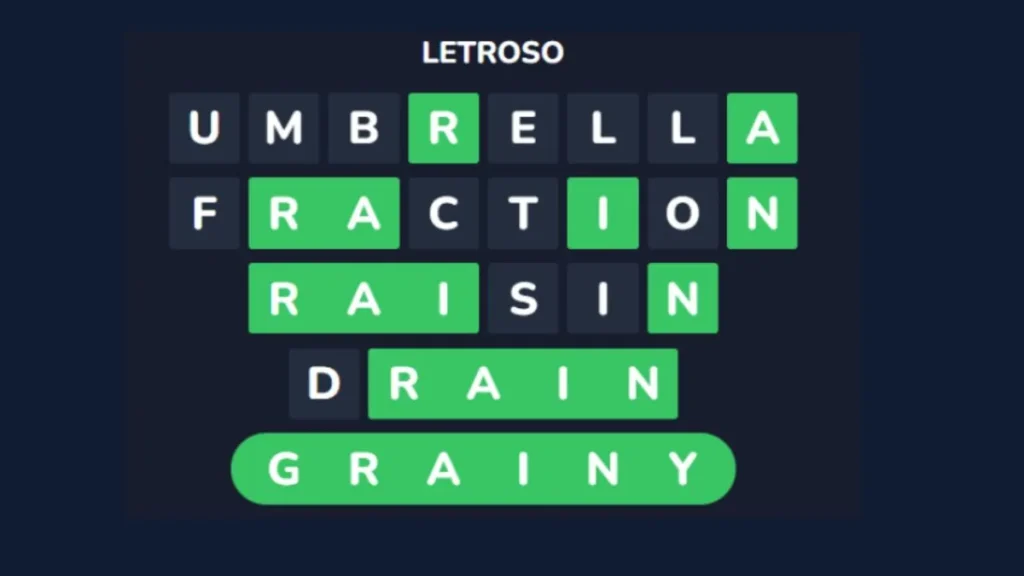
Letroso comes from the same developer as Contexto, which tells you a lot about what to expect. It keeps the unlimited guessing format that Contexto players love but swaps out the semantic AI system for something closer to Wordle’s letter-based feedback with a few clever additions.
The word length changes every day, anywhere from three to ten letters. Color-coded tiles show you which letters are correct, and rounded tile edges give you a visual hint when you have found a letter that sits at the start or end of the word.
- Green tile means the correct letter in the correct position
- Yellow tile means a correct letter in the wrong position
- Rounded edges on a tile mean that the letter appears at the beginning or end of the secret word
How it differs from Contexto: Letroso does not use semantic similarity or AI ranking. It is letter-position feedback, not meaning-based feedback. The variable word length also makes each day unpredictable in a different way.
How it is similar to Contexto: Unlimited guesses, one daily secret word, and it is made by the same developer. If you like Contexto’s patient-friendly format, Letroso fits naturally alongside it.
Difficulty vs Contexto: Medium. Variable word length adds challenge, but the letter feedback is more direct than Contexto’s ranking system.
Best for: Contexto players who want a change of pace without switching to a completely different type of game.
Find today’s Letroso answer on gamingwize.
4. NYT Connections
Connections is one of the most shared puzzle games on social media right now. Each day, you get 16 words, and your job is to sort them into four groups of four. Each group shares a hidden theme. The trick is that many words could plausibly fit into more than one category, which is exactly what makes it so difficult.
The 4 categories are color-coded by difficulty:
- Yellow is the easiest
- Green is medium
- Blue is hard
- Purple is the one that will make you question everything.
How it differs from Contexto: Connections is about spotting relationships between words in a group, not finding a single hidden word through meaning. You get four mistakes before the game ends, so it is far less forgiving than Contexto’s unlimited guessing.
How it is similar to Contexto: Both games ask you to think about how words relate to each other. The category-spotting in Connections and the semantic guessing in Contexto both reward people who think broadly and laterally about language.
Difficulty vs Contexto: Medium to hard. The purple category in particular is designed to mislead you.
Best for: Players who enjoy wordplay, lateral thinking, and the satisfaction of spotting a theme others miss.
See today’s NYT Connections hints before you run out of attempts.
5. NYT Strands
Strands is a newer addition to the NYT puzzle lineup and one that rewards patience. You get a grid of letters and need to find hidden words that all connect to a daily theme. One special word called the Spangram stretches across the entire grid and gives you the biggest hint about what the theme actually is.
Unlike most word searches, the letters in each word must connect in sequence, meaning you trace a path through the grid rather than just spotting letters in a line.
How it differs from Contexto: Strands is visual and spatial. You are tracing paths through a letter grid rather than typing guesses and reading a rank. There is no AI similarity scoring involved.
How it is similar to Contexto: Both games revolve around a central theme or concept. In Contexto, every word you guess is ranked by its relationship to the secret word. In Strands, every word you find connects back to the day’s theme.
Difficulty vs Contexto: Medium. Finding the Spangram first makes the rest significantly easier.
Best for: Players who enjoy theme-based puzzles and want something more visual than a text-input guessing game.
Check today’s NYT Strands hints if the theme has you stumped.
6. Letter Boxed
Letter Boxed is one of the more unusual puzzles in the NYT lineup. You get 12 letters arranged on the four sides of a square, three letters per side. The goal is to use all 12 letters to make words, with one rule: consecutive letters in a word cannot come from the same side of the box.
Each new word must also start with the last letter of the previous word, which forces you to think several moves ahead rather than just grabbing obvious words.
How it differs from Contexto: Letter Boxed is a chain-based word puzzle with spatial rules. There is no guessing, no ranking, and no secret word to uncover. The challenge is efficiency: solving the board in as few words as possible.
How it is similar to Contexto: Both reward creative thinking about vocabulary. The best Letter Boxed players, like the best Contexto players, tend to think in word families and associations rather than individual words in isolation.
Difficulty vs Contexto: Hard. The constraint of not repeating the same-side letters catches most people off guard until they develop a feel for it.
Best for: Players who enjoy strategic word puzzles and do not mind spending ten minutes on a single board.
See today’s Letter Boxed answer for the day’s solution.
7. NYT Pips
NYT Pips is one of the newer puzzles from the New York Times and takes a different direction from the rest of the list. It is a number and word hybrid where you match tiles based on shared properties. The game is quick by design, built for people who want something done in under three minutes.
How it differs from Contexto: Pips is not a pure word game. It blends pattern recognition with quick categorization, which makes it feel closer to a card game than a vocabulary test.
How it is similar to Contexto: Both are daily browser puzzles with a clean, minimal interface. Both reward pattern thinking over random guessing.
Difficulty vs Contexto: Easier. Rounds are short, and the feedback is immediate.
Best for: Players who want a fast daily puzzle to pair with their usual word game rotation.
Find today’s NYT Pips answers on gamingwize.
8. Semantle
Semantle is the direct ancestor of Contexto. The developer of Contexto built their game as an improvement on Semantle, so playing both back to back shows you exactly how the genre evolved.
The concept is identical: find the secret word by guessing words and receiving feedback based on semantic similarity. Where Contexto gives you a numerical rank, Semantle gives you a similarity score between 0 and 100. A score of 100 means you found the word. Anything below 20 means you are far off.
How it differs from Contexto: Semantle uses a 0 to 100 score instead of a rank-based system. There is no color grading. The interface is more minimal, and the feedback can feel less intuitive until you get used to reading the scores.
How it is similar to Contexto: The core mechanic is identical. Both use word embedding AI to measure how semantically close your guess is to the answer. Both have unlimited guesses and a single daily word.
Difficulty vs Contexto: Harder. The 0 to 100 score gives you less directional guidance than Contexto’s rank plus color system. Players often find themselves stuck in a score range with little idea of which direction to go.
Best for: Contexto players who want a purer, more stripped-back version of the same challenge.
Where to play: semantle.com
9. Cemantle
Cemantle takes Semantle’s semantic guessing mechanic and replaces the scoring system with a temperature scale. Guesses that are far from the answer are rated cold, down to minus 100 degrees. Guesses that get close start warming up, all the way to plus 100 degrees. A secondary percentile score tracks your overall progress toward the answer.
The temperature framing makes the feedback feel more intuitive for some players. Warm means keep going in this direction. Cold means try something completely different.
How it differs from Contexto: The temperature scale is more descriptive but less precise than Contexto’s numerical rank. Cemantle also shows a progress percentile, which Contexto does not have, giving you a broader sense of how close you are overall.
How it is similar to Contexto: Same unlimited guessing format, same daily reset, same AI-powered semantic similarity engine under the hood.
Difficulty vs Contexto: Comparable. Some players find the temperature framing easier to interpret; others prefer Contexto’s direct ranking.
Best for: Players who find Contexto’s rank numbers abstract and want a more descriptive feedback system.
Where to play: cemantle.certitudes.org
10. Pimantle
Pimantle builds on the Semantle formula and adds something genuinely different: a 2D visual map that plots every guess you make based on its semantic distance from the answer. The secret word sits at the center of the map. Every guess appears as a dot, positioned closer or further from the center depending on how semantically similar it is.
This means you can literally see your guesses clustering around the answer over time, which gives you a spatial sense of which direction your thinking should go.
- Each guess comes with a proximity score and a temperature label such as cool, warm, toasty, or hotman
- The 2D map updates in real time as you add more guesses
- The visual clustering often reveals patterns that pure numbers do not
How it differs from Contexto: The 2D map is Pimantle’s biggest differentiator. No other game on this list gives you a visual representation of your guessing history laid out spatially. It changes how you approach the puzzle entirely.
How is it similar to Contexto: Unlimited guesses, semantic similarity scoring and one daily word. The core loop is the same.
Difficulty vs Contexto: Comparable, though the visual map often makes it easier to spot patterns and course-correct faster than Contexto’s rank alone allows.
Best for: Visual thinkers who want to see their progress mapped out rather than just read a number after each guess.
Where to play: semantle.pimanrul.es
Ranked by Difficulty: Easiest to Hardest Contexto Alternatives
One of the most common questions from Contexto players looking for alternatives is which game is harder and which one is more forgiving. Here is every game on this list ranked from easiest to hardest, with a one-line reason for each placement.
- NYT Pips: Rounds finish in under three minutes, and the feedback is immediate, making it the most approachable game on this list by a wide margin.
- Wordle: Six guesses sounds tight, but the letter-position feedback is precise enough that most players find the answer within four or five attempts once they develop a starting word strategy.
- NYT Strands: Finding the Spangram first unlocks the theme and makes the remaining words significantly easier to spot. The difficulty comes mostly from the first two minutes.
- Spelling Bee: Finding common words is easy. Reaching Genius or Queen Bee status requires digging into obscure vocabulary that most players have never had reason to use in daily conversation.
- Letroso: Variable word length between three and ten letters means some days the puzzle is over quickly, and others feel genuinely punishing. The average difficulty sits just above Contexto.
- NYT Connections: The purple category is specifically designed to mislead experienced players. Many people who breeze through the yellow and green categories hit a wall on blue and purple every single day.
- Letter Boxed: The same-side letter restriction creates word chains that most people do not think in naturally. Solving the board in two or three words, which is the real challenge, requires vocabulary and planning that takes time to develop.
- Cemantle: The temperature scale is descriptive but less precise than Contexto’s rank system. Players often plateau at a warm rating with no clear sense of which vocabulary direction to push toward next.
- Pimantle: The 2D map helps visual thinkers, but the underlying semantic model is less forgiving than Contexto’s. Getting your guesses to cluster tightly around the center of the map without the word itself showing up is a uniquely frustrating experience.
- Semantle: The hardest game on this list by a clear margin. A raw score between 0 and 100 with no color guidance and no rank means you can spend an hour making technically correct progress without feeling like you are getting anywhere. The average Semantle player uses significantly more guesses than the average Contexto player.
Which Games Like Contexto Work on Mobile?
One of the most common frustrations with browser-based puzzle games is opening them on your phone and finding a layout that was clearly built for a desktop screen. The good news is that most games on this list were designed with mobile in mind from the start, since the majority of daily puzzle players are on their phones.
Here is a full breakdown of how each game performs across devices in 2026.
| Game | iOS App | Android App | Mobile Browser | Desktop Browser |
|---|---|---|---|---|
| Wordle | Download | Download | Yes | Yes |
| Spelling Bee | Download | Download | Yes | Yes |
| Letroso | Play on Web | Play on Web | Yes | Yes |
| NYT Connections | Download | Download | Yes | Yes |
| NYT Strands | Download | Download | Yes | Yes |
| Letter Boxed | Download | Download | Yes | Yes |
| NYT Pips | Download | Download | Yes | Yes |
| Semantle | Play on Web | Play on Web | Yes | Yes |
| Cemantle | Play on Web | Play on Web | Yes | Yes |
| Pimantle | Play on Web | Play on Web | Yes | Yes |
A few things worth noting from the table above.
All seven NYT games, including Wordle, Spelling Bee, Connections, Strands, Letter Boxed, and NYT Pips, are available inside the New York Times Games app on both iOS and Android. The app is free to download, but some games require a NYT Games subscription to access without limits. Wordle remains completely free inside the app with no subscription needed.
Letroso, Semantle, Cemantle, and Pimantle have no dedicated mobile apps as of 2026. All four work through your mobile browser, and the experience is reasonably good on most modern smartphones. Pimantle’s 2D map can feel slightly cramped on smaller screens but remains usable. Semantle and Cemantle are text-input-based, so they translate to mobile without any real issues.
If you play primarily on your phone and want the smoothest experience, the NYT Games app is worth downloading. It keeps all your streaks, tracks your stats, and loads significantly faster than opening individual browser tabs each morning.
Is Semantle harder than Contexto?
Yes, Semantle is harder than Contexto for most players. Contexto gives you a numerical rank plus a color grade after every guess, which together point you in a clear direction. Semantle only gives you a similarity score between 0 and 100 with no color guidance. Players who switch from Contexto to Semantle typically use a much higher number of guesses before finding the answer.
What is the easiest Contexto alternative?
NYT Pips is the easiest game on this list. Rounds are short, feedback is immediate, and the format is far more forgiving than Contexto’s open-ended semantic guessing. If you are new to daily browser puzzles and find Contexto overwhelming, Pips is the best starting point.
Are there Contexto alternatives with unlimited plays?
Yes, several games on this list offer unlimited play beyond the daily puzzle. Semantle, Cemantle, and Pimantle all allow you to play past puzzles from their archives. Spelling Bee through the NYT Games app also lets subscribers access previous puzzles. Wordle, Connections, Strands, and Letter Boxed are strictly one puzzle per day, with no archive access for free users.
What game is most similar to Contexto?
Semantle is the closest game to Contexto in terms of core mechanics. Both use AI-powered word embeddings to measure semantic similarity between your guess and the secret word. Contexto was directly inspired by Semantle, so the two games share the same fundamental idea with different scoring and interface choices on top.
Is Wordle similar to Contexto?
Wordle and Contexto share the same basic premise of guessing a hidden word with feedback after each attempt, but the mechanics are quite different. Wordle is about letter positions in a five-letter word with a six-guess limit. Contexto is about semantic meaning with unlimited guesses and no letter constraints. They feel different to play but appeal to a similar type of player.
Do any of these games have a free version?
Every game on this list has a free version. Wordle, Letroso, Semantle, Cemantle, and Pimantle are completely free with no subscription required. NYT Spelling Bee, Connections, Strands, Letter Boxed, and Pips are free to play once per day through the browser. A NYT Games subscription unlocks additional features like stats tracking and archive access, but is not required to play the daily puzzle.
What replaced Contexto as the most popular semantic word game?
Contexto remains one of the most played semantic word games in 2026. No single game has replaced it. Semantle is older and more niche. Cemantle and Pimantle have smaller but dedicated player bases. Contexto holds its position largely because its rank plus color feedback system strikes the right balance between challenge and accessibility for the widest range of players.
Is there a Contexto alternative for kids?
Wordle is the most kid-friendly option on this list. The five-letter word format is straightforward enough for older children, and the color feedback is easy to understand without any explanation. NYT Strands is also a good option for kids who enjoy word searches since the grid-based format feels familiar. Semantle, Cemantle, and Pimantle are too abstract for younger players and are better suited to adults.


